Is wet food better for cats? Wet vs dry, how to combine them, and why water is the real question
Is wet food better for cats than dry? Ask ten cat owners and you will get ten answers. The honest one is that wet and dry food each do something the other cannot, and most cats do best on a bit of both. What decides it is not the marketing on the pack but a quirk of cat biology: cats are bad at drinking.
Cats are built to get water from food
Domestic cats descend from desert hunters whose prey was around 70% water. Their thirst reflex is weak, so a cat on an all-dry diet often drinks less than it loses and lives in a state of mild dehydration. That matters because concentrated urine is one of the main drivers of the urinary and kidney problems vets see most often in cats.
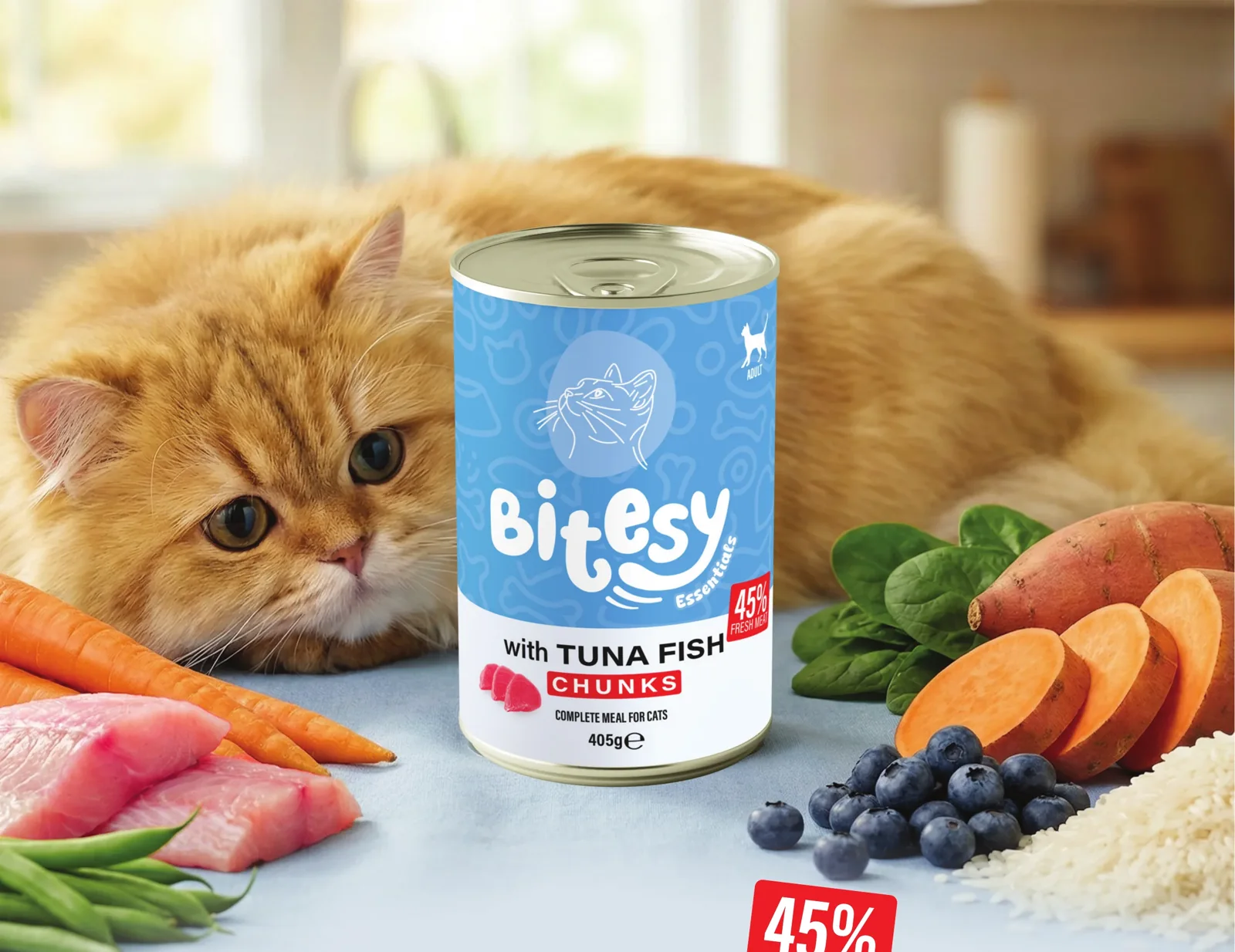
A complete wet food is roughly 75 to 80% moisture. One 405g can of Bitesy Essentials Cat wet food delivers more water than most cats will drink from a bowl in a day. That is the strongest argument for wet food, and it is a health argument rather than a taste one.
What dry food does well
Dry food is not the villain some social media posts make it. A complete dry food is nutritionally dense, so a small portion delivers the full daily requirement of protein, fat, vitamins and minerals. It keeps for weeks once opened, it can be left out for grazers and it makes free-feeding practical for a household that is out all day. It is also the most economical way to feed a cat properly. Bitesy Essentials Cat is formulated as a complete food on its own, with taurine added for heart and eye health.
The case for mixing
Combining the two is what most vets recommend in practice. Wet food covers hydration and palatability; dry food covers convenience and cost. The mistake people make is to add wet food on top of the usual dry portion, which is how indoor cats gain weight. Treat the two as one daily ration: if you add a can, reduce the kibble by the same share of calories.
- Kittens: wet food is ideal while they learn to eat; the mousse texture of the Bitesy Platinum kitten mousse is designed for small mouths and weaning, fed alongside a complete kitten food.
- Sterilised cats: lower energy needs and a higher risk of urinary issues make wet food particularly useful. Our sterilised recipe adds L-carnitine to support a healthy weight.
- Senior cats: softer food is easier on worn teeth and encourages fussy older cats to keep eating.
How to switch without a strike
Cats are creatures of habit and a sudden change can end in a hunger strike. Introduce the new food over seven to ten days, mixing a little more each day. Serve wet food at room temperature, in a wide shallow dish so whiskers do not touch the sides, and lift what is left after about half an hour.
What to look for on the label
Whatever you choose, look for the word complete: it means the food on its own provides everything your cat needs, which a "complementary" food does not. Then look at the first ingredient. Bitesy wet recipes for cats start with 45% fresh meat or fish, name the protein and its percentage, and add taurine and vitamins A, D3 and E in every can. The full composition of every recipe is published on this site, so you never have to guess.
Frequently asked
Is wet food bad for cats' teeth?
No. Dental disease is driven by plaque and genetics rather than food texture, and ordinary kibble does very little cleaning. Regular dental checks matter far more than the wet-versus-dry choice.
Can I feed wet food only?
Yes, as long as it is a complete wet food and you feed the amount on the pack for your cat's weight. Many owners keep a small measure of dry food for convenience.
How much water should a cat drink?
Roughly 50 ml per kilogram of body weight a day from all sources. A 4 kg cat needs about 200 ml; a can of wet food covers most of that.
More from the blog

Mono-protein cat food: what it is, and which cats really need it
Mono-protein (single-protein) cat food explained: what it means, why it helps cats with food sensitivities and itchy skin, and how to use it in an elimination diet.

Best dog food for skin allergies? Why fish, seabream and salmon, is the place to start
Looking for the best dog food for skin allergies? Why fish-based dog food helps with itchy skin and dull coats: omega-3 from seabream and salmon, dual-protein recipes, and how Bitesy Platinum Dog uses fresh Mediterranean fish.

Taurine in cat food: the nutrient every complete cat food must contain, and why
What taurine does for cats, why cats cannot make enough of it, what happens when it is missing, and how to check a cat food label for it.